19 September 2022/Terje Ennomäe
Finding actionable insights with conversation analytics
Most teams have plenty of customer data and very little idea what to do with it. Once every call, chat and email is transcribed and searchable, the sheer volume can be overwhelming — there is no obvious place to start, and it is easy to end up admiring dashboards instead of changing anything.
The way through is to work backwards from a decision. Start with a strategic goal, turn it into a business question, then use analysis to answer that question and act. This article walks through a worked example of exactly that process, using demo chat data.
Start with the strategy, not the data
Before you touch a single conversation, get clear on two things:
- What are my company's and my department's current strategic goals?
- Related to those goals, what are my business questions?
Suppose the strategic goal is to shift more customers towards self-service. Two useful business questions follow:
- How many contacts do we receive about self-service?
- What are customers finding difficult with self-service?
Answering them is a multi-stage process. First you measure the size of the topic, then you dig into the reasons behind it.
How big is the issue?
To size the topic, look at the total number of conversations for your chosen period and how often self-service comes up within them. A good search does not rely on a single keyword — it also captures the other ways customers and agents refer to the same thing, so you catch the whole topic rather than one exact phrase.
In the demo data, self-service (or the website it lives on) is mentioned in more than half of all conversations. That alone tells you the topic is worth attention. If your website and self-service portal are genuinely separate, you might exclude website mentions; in the demo they overlap, so they are analysed together.
What are customers feeling?
The next question is sentiment. When you look only at conversations that mention self-service, most are positive — but more than a quarter are negative. For a topic this large, that is high enough to warrant a closer look.
Sentiment is one signal. You can also count conversations where explicit indications of a problem appear alongside self-service mentions. Together they answer the first business question: self-service is mentioned in over half of conversations, and a significant share of those are negative. There is clear room for improvement.
From facts to actionable insight
Knowing the topic is big and often negative is a fact. To make it actionable, you need to know why.
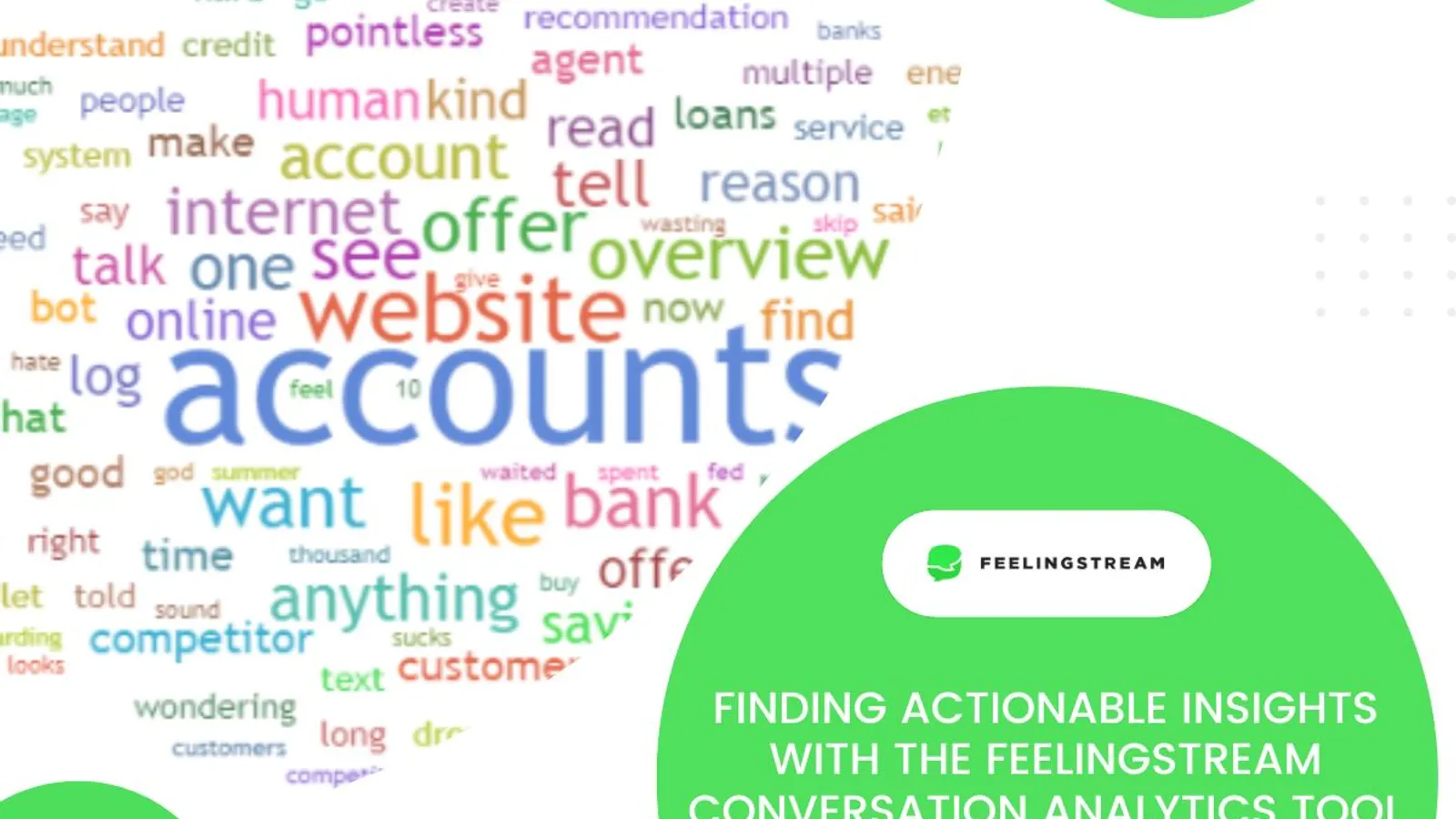
A word cloud built from the negative, self-service-related conversations is a quick way in. In the demo data, "information" sits right at the centre. Rather than reading every transcript, you can follow the strongest signals — words like "unable" and "information" — and click through to the conversations behind them.
One trap to watch for: the word "unable" turned out to appear mostly inside a chatbot's stock phrase ("I am sorry, I am unable to understand what you need"), not in the customers' own words. Because the goal here is self-service, not bot tuning, the fix is to filter the word cloud to customer text only. Doing so changes the picture entirely — the central word becomes "accounts", and the conversations reveal that customers cannot easily find the account overview page, or find it but see incomplete data.
Now there is an insight worth acting on: a specific, findable cause of negative self-service conversations.
Turning insight into action
An insight only becomes valuable when someone owns it. Take the finding — and the supporting customer quotes — to the team that manages self-service, so they can make the account overview page easier to reach and more complete.
Once the change ships, use conversation analytics to monitor the effect. Are those calls and chats reducing? What do customers talk about now? Making changes one step at a time, and measuring after each, lets you reduce avoidable contact gradually and with confidence.
Change is a gradual process
Working towards actionable insight starts with strategy and questions, not with the data. And finding an improvement is only half the job — you also need resources to act: people, ownership and time. Even small process fixes add up when you measure them and keep going.
Frequently asked questions
What is the difference between a fact and an actionable insight?
A fact describes what is happening — for example, "a quarter of self-service conversations are negative". An actionable insight explains why and points to a specific change, such as "customers cannot find the account overview page". Only the second one tells you what to do.
Where should I start when the data feels overwhelming?
Start with a strategic goal, turn it into one or two business questions, and let those questions drive the analysis. It stops you drowning in interesting-but- irrelevant detail.
How do word clouds help find the root cause?
A word cloud surfaces the most common terms in a filtered set of conversations, giving you fast entry points to investigate. Filtering to customer text (rather than agent or bot text) keeps the signal focused on what customers actually say.
How do I know a change worked?
Re-run the same analysis after the change and compare. If the relevant conversations reduce in volume or shift in sentiment, the change is working — if not, you adjust.
Where to go next
- Pillar guide: What is conversation analytics?
- The platform: Product overview
- Related reading: Mere facts versus actionable insights
- See it on your data: Request a demo
Want to turn your own conversations into decisions rather than dashboards? Book a demo and we will walk through this process on your data.