26 November 2020/Terje Ennomäe
How customers speak across service channels
Once you transcribe customer calls into text, they become searchable — a little like searching the web. But finding business-critical insight in real call transcripts is not the same task as looking something up on a search engine, and the difference trips up almost every new user.
The reason is simple: a call is spontaneous speech between two people making sense of each other in the moment. A web page is written by someone who thought carefully about how to be found. Search the transcripts as if they were web pages and you will come up empty. This post explains why — and what to search for instead.
Searching the web versus searching real conversations
Search the web and you get texts written by people with a message to share, often crafted specifically to be discoverable. Search transcribed calls and you get something quite different: language produced on the fly, with no thought for how someone might retrieve it later.
New users understandably start by typing a keyword from their own line of work and searching for related calls. Very often they find nothing relevant — not because the calls do not exist, but because customers simply do not talk the way we write. Finding insight in transcripts requires a new mindset about which keywords to choose.
What spontaneous conversation actually looks like
People rarely speak in tidy, complete sentences. In everyday talk they:
- Start mid-thought, often not from the most logical place.
- Abandon one idea to insert another halfway through.
- Pause frequently and pepper their speech with filler words.
- Talk over each other, or misunderstand one another entirely.
Clients are often surprised the first time they read a real call transcript. They expect something like a clean theatre script and instead find speech that looks long-winded, incoherent and hard to interpret at first glance. That is not a flaw in the transcription — it is simply how normal people speak.
The practical lesson: to find relevant calls, stop thinking in web-search keywords and start asking "how would an ordinary person say this out loud?"
The same request, three different channels
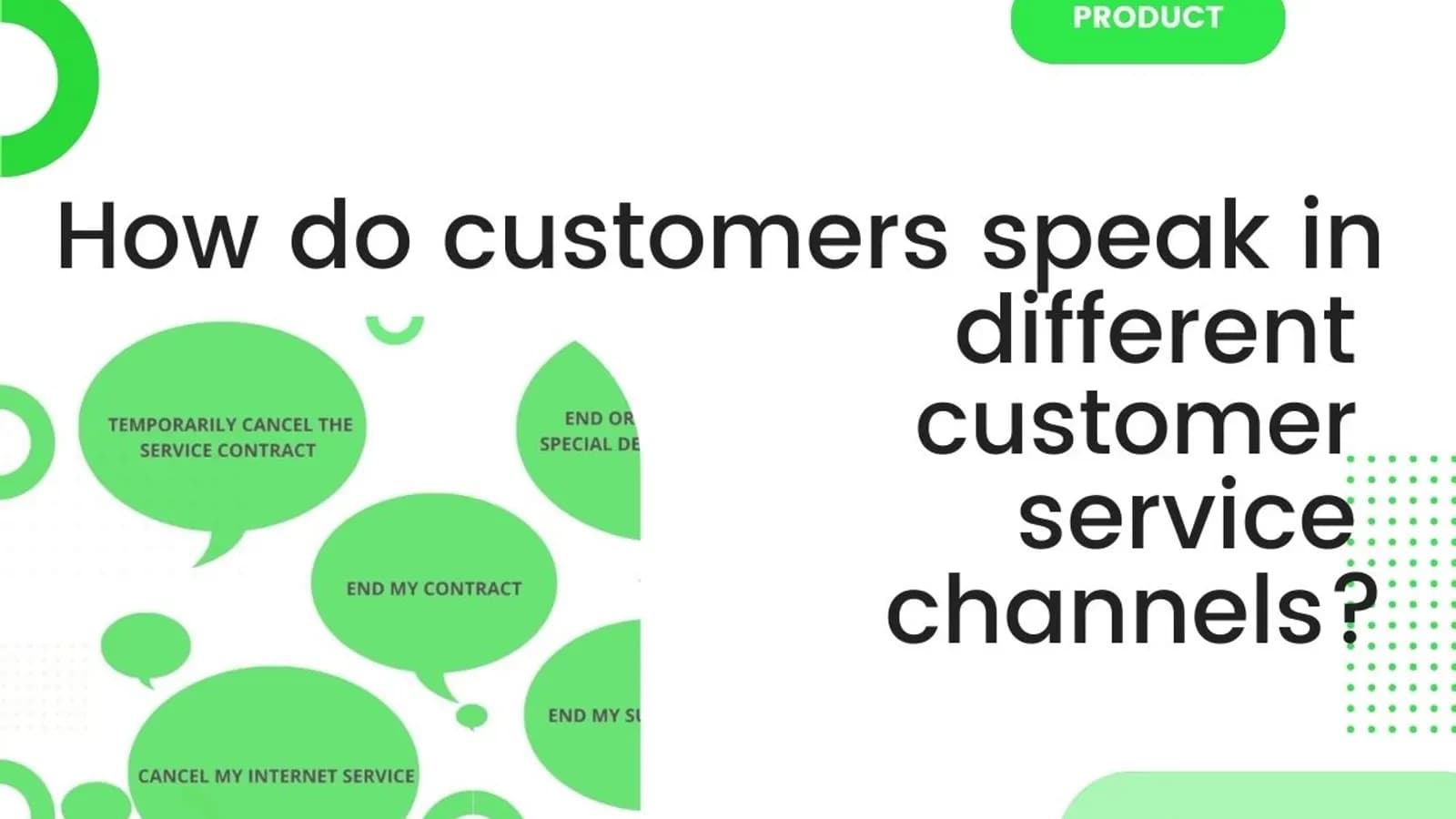
Consider customers who want to end their contract. On the web you would type "terminating service contracts" and get plenty of matches. Real customers express that same goal very differently — and the wording depends on the channel they chose.
- Live chat tends to be short and concise. Both sides have had a moment to think, so the request and the agent's reply are brief and to the point.
- Email is fuller. A customer might lay out the context — selling their flat, say — and every detail up front, deliberately reducing the back-and-forth to come.
- Phone calls are the most varied of all. Across three different callers you might see three completely different ways of asking to end or pause a contract, each with its own reasoning and its own reason for phoning rather than using self-service.
Because there are so many ways to express one intent, the neat web-search phrase returns almost nothing when applied to real calls. The everyday, spontaneous expressions people actually use are the real keywords worth searching for.
Why this matters for customer insight
Customer interactions are a new kind of data, and they reward a new way of finding insight — for example, understanding why customers are leaving. Because conversation analytics brings chat, email and calls into one place (with personal data anonymised), you can compare how the same intent surfaces in each channel and search using the words customers really use.
In practice that means:
-
Transcripts of calls ready to search shortly after each call.
-
Ad-hoc insight search, with AI surfacing the common expressions and words customers use so you do not have to guess the phrasing.
-
Fast statistical overviews across all calls, emails or chats — or a combination — over any period or for any team.
-
Custom searches for recurring needs such as monthly insight reports, quality assurance and sales-script adherence.
Frequently asked questions
Why can't I search call transcripts like a web search?
Because calls are spontaneous speech, not written-for-search text. Customers use everyday, unpolished language, so the tidy keywords that work on the web rarely match what people actually said.
How should I choose search terms for transcripts?
Think about how an ordinary person would say the thing out loud, in everyday words, rather than the formal phrase you would type into a search engine.
Why does the same request look so different across channels?
In chat and email people have time to compose a clear, concise request. On the phone they speak spontaneously, so the same intent appears in many varied, less-structured ways.
Can I analyse chat, email and calls together?
Yes. Bringing every channel into one place lets you compare how customers express the same intent and search across all of them at once.
Where to go next
- The pillar guide: What is conversation analytics?
- Turn calls into searchable text: Multilingual speech-to-text
- Use the insight: Automatic quality scoring
Curious how your customers really phrase things across chat, email and calls? Book a demo and we will search your own conversations with you.