8 July 2026/Terje Ennomäe
The 40% problem: why the right offer never reaches your customer
Most contact centres don't have an offer problem. They have an offer delivery problem.
The campaigns are designed. The next-best-offer logic knows which customer should hear which proposal. The talking points are written, the training is done. And then the call starts — and the offer never comes up.
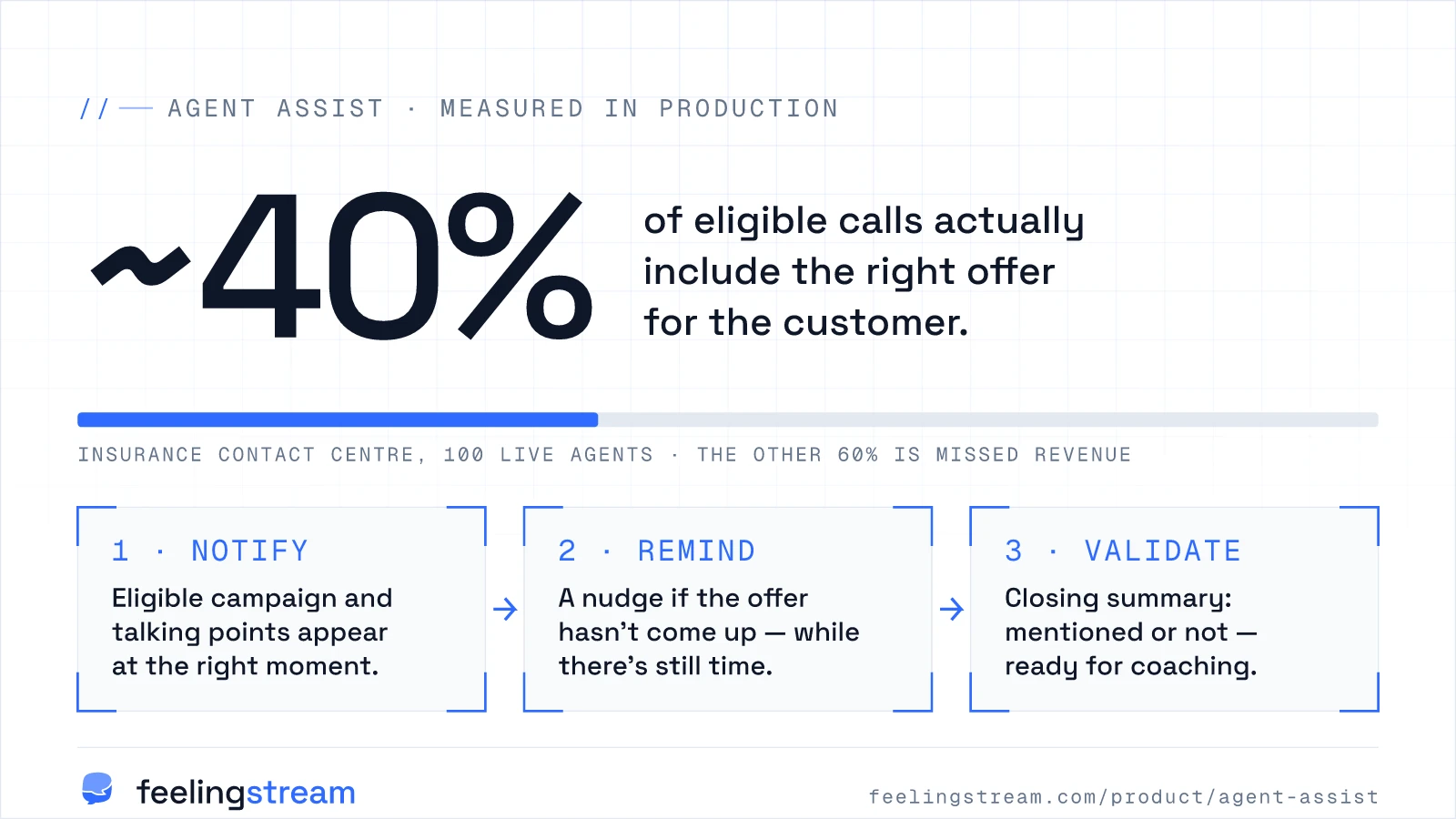
One insurance contact centre we work with measured it. Across their eligible calls — conversations where a relevant product or cross-sell offer existed for that customer — the appropriate offer was actually presented in roughly 40% of cases.
Not because agents didn't care. Because a live call is a hard place to remember everything.
Where the other 60% goes
During a call, an agent is listening, navigating systems, handling objections and following mandatory steps — all at once. In that flow, three things happen to a planned offer:
It's forgotten. No agent holds every active campaign, eligibility rule and argument in memory. The more campaigns you run, the worse this gets.
It's mistimed. The natural opening appears mid-call, passes in seconds, and forcing the offer at the end feels pushy — so the agent skips it.
It's diluted. The offer is mentioned, but without the arguments that make it land, and the customer hears a price instead of a reason.
None of this shows up in your CRM. The campaign dashboard says "active", the call ends, and the gap between strategy and delivery stays invisible — unless someone listens to the calls.
Why this is the cheapest growth lever you own
The interesting part of the 40% baseline is what it implies. You don't need more leads, more calls or more agents to grow. You need a larger share of the calls you already handle to include the offer your own logic already selected.
A simple model shows the scale. Take a 100-agent contact centre with 40,000 eligible calls a month:
- Raising the offer-presentation rate from 40% to 55% means 6,000 more customers a month hear the right offer.
- At a 5% conversion rate, that's 300 incremental sales a month — from the same call volume, the same marketing spend, the same headcount.
The exact numbers will differ for every operation — these are illustrative, and we're happy to build the model on your own volumes. But the lever itself is universal: offer-presentation rate is measurable, and it moves.
Closing the gap during the call, not after it
Post-call analytics can tell you the offer was missed. That's useful for coaching — and a month too late for the customer who already hung up.
This is what Agent Assist is built for. It works in three steps during the live, transcribed conversation:
- Notify. When the call context is known, the agent sees the eligible campaign and its talking points — at the right moment, not at call start.
- Remind. If the conversation is progressing and the offer hasn't come up, a short on-screen nudge appears while there is still time to act.
- Validate. As the call wraps up, a closing summary records whether the offer was mentioned — giving team leads something concrete to sample and coach on.
The agent stays in control throughout. Prompts are nudges to use, adapt or ignore — not a script. And because every prompt and outcome is recorded, managers finally see how campaigns play out in real conversations instead of guessing.
Start by measuring your own baseline
Every contact centre has a number like 40%. Most have never measured it. That's the first step: find out what share of your eligible calls actually include the right offer. From there, every percentage point of improvement has a revenue figure attached.
Want to know your number? Book a demo and we'll show you how offer execution looks on your own calls.
Frequently asked questions
What counts as an "eligible call"?
A conversation where your own campaign or next-best-offer logic has identified a relevant offer for that customer — the calls where an offer should be presented.
Does prompting agents make calls longer or pushier?
No. The aim is timing, not pressure. The prompt surfaces the offer when it fits the conversation, and the agent decides how — or whether — to use it.
Does Agent Assist replace our next-best-offer engine or CRM?
No. It activates the logic you already have. Campaign codes come from your environment; Agent Assist turns them into live prompts and measurable execution. It complements CRM and telephony rather than replacing them.
How do we know it's working?
Offer-presentation rate is tracked continuously: prompts shown, offers mentioned, closing summaries per call. You see the baseline move instead of waiting for quarterly results.
Where to go next
- The product: Agent assist
- The bigger picture: Real-time support: how Agent Assist helps every call
- The sales angle: Real-time guidance for contact centre sales
Want to see offer execution on your own calls? Book a demo and we'll show you where the right offer is being missed.