10 July 2026/Terje Ennomäe
Your agents are selling, just not what you planned
Ask most sales leaders why campaign results disappoint, and you will hear a version of the same theory: agents do not sell enough. Too cautious, too busy, too focused on service.
We recently analysed 18,000 sales-assigned calls at a contact centre to test that theory. The data said something else entirely.
Agents attempted a sale on 81% of calls.
The effort is there. Eight out of ten conversations included a genuine sales attempt, with real arguments. Whatever is leaking revenue, it is not motivation.
Then we looked at what they were selling.
The mismatch nobody sees
Each call in the analysis had an assigned campaign — the offer the next-best-offer logic had selected for that specific customer. Here is how the calls actually played out:
- 35% pitched the assigned campaign. Strategy and execution aligned.
- 45% pitched a different product. The agent sold — confidently, often successfully — but not the offer chosen for that customer.
- 19% made no sales attempt at all.
Read that middle number again. On nearly half of all calls, the sales effort was spent on the wrong offer. The campaign dashboard says "active", the agent's numbers say "selling", and the gap between the plan and the call stays completely invisible — because everyone's metrics look fine.
Why mismatch is more expensive than silence
A missed sale is an obvious loss. A mismatched sale is a hidden one — something was sold, so nobody investigates. But the assigned campaign existed for a reason: it was the offer with the highest expected value for that customer, based on data the agent cannot hold in their head.
Two more numbers from the analysis make the cost concrete:
When agents did pitch, 23% of customers accepted. The offers work. Conversion is not the bottleneck — delivery is.
Even on calls with no sales attempt, 8% of customers signalled purchase intent on their own. Customers ready to buy, with nobody selling.
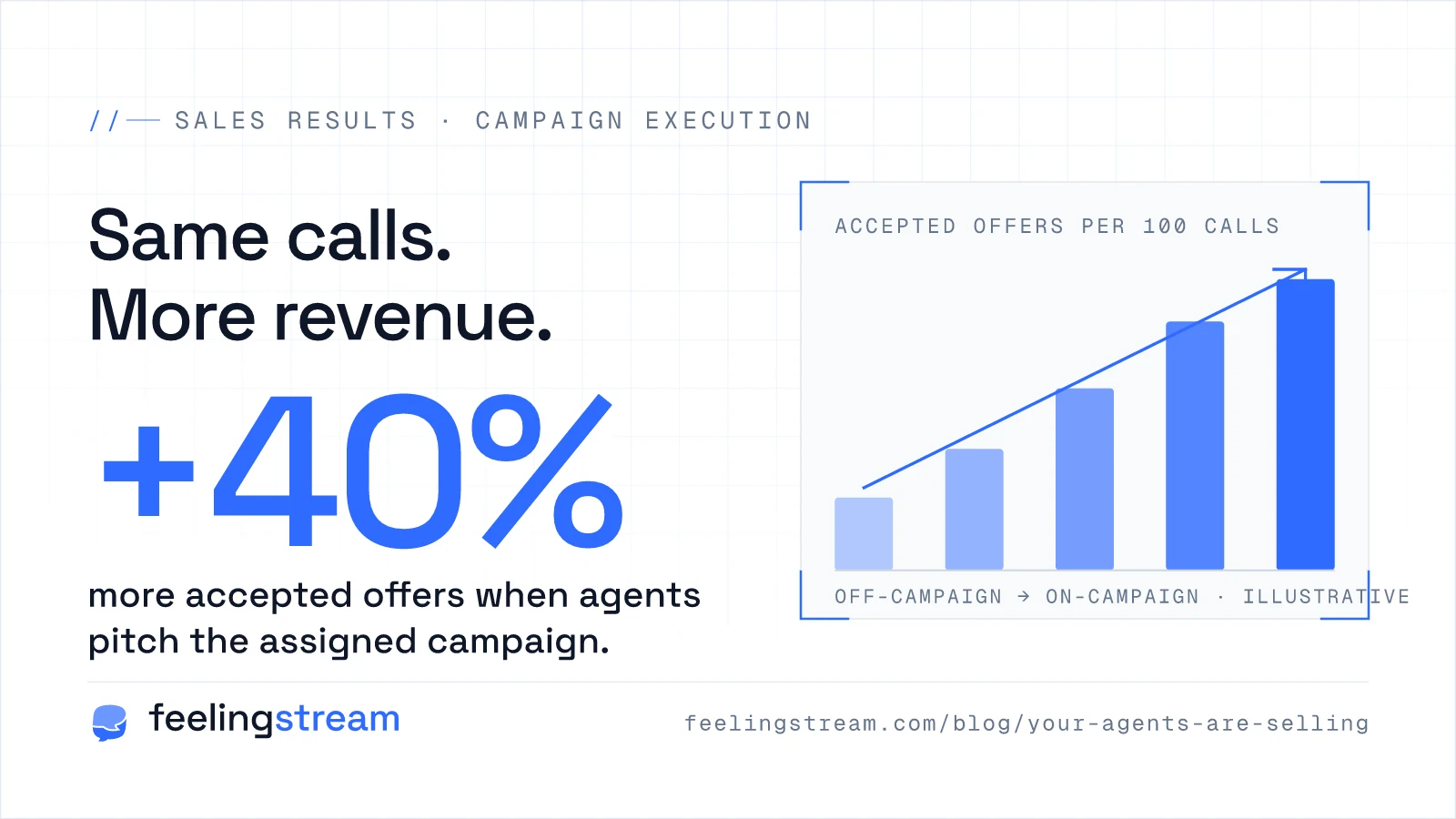
Put together: every call that moves from wrong-pitch or no-pitch to right-pitch carries roughly a one-in-four chance of acceptance. In this dataset, shifting even half of the off-campaign calls onto the assigned offer would have increased accepted offers by around 40%. Same agents, same calls, same effort — pointed in the right direction. (Illustrative model — we will gladly run it on your volumes.)
Why this happens — and why training will not fix it
No agent can hold every active campaign, eligibility rule and argument in memory while listening, navigating systems and handling objections. Under pressure, they reach for the product they know best — the one they sold successfully yesterday. That is not a discipline problem. It is a working-memory problem, and more training slides will not solve it.
What solves it is putting the assigned offer in front of the agent during the call:
- Notify — when the call context is known, Agent assist shows the agent the assigned campaign and its talking points.
- Remind — if the conversation is progressing and the offer has not come up, a short nudge appears while there is still time.
- Validate — at wrap-up, a closing summary records what happened: pitched, mismatched or silent.
The agent stays in control — prompts are nudges to use, adapt or ignore. But the guessing ends. And for the first time, managers can see execution per call instead of inferring it from topline conversion.
Measure your own three numbers
Every sales-focused contact centre has these three numbers: what share of calls pitch the assigned offer, what share pitch something else, and what share stay silent. Almost nobody has measured them — because until calls are transcribed and analysed, they are unmeasurable.
That is the place to start. Not with assumptions about agent effort — with the actual split.
Want to know yours? Book a demo and we will show you the pitched / mismatched / silent breakdown on your own calls.
Frequently asked questions
Is a mismatched sale not still a good sale?
Sometimes. But the assigned campaign was selected as the highest-value offer for that customer. When 45% of calls ignore it, campaign ROI becomes random — and the customers most likely to accept a specific offer never hear it.
Are agents doing something wrong?
No — that is the point. Agents sold on 81% of calls. They default to products they know because nobody can memorise every campaign. The fix is support during the call, not blame after it.
How is the split measured?
Calls are transcribed live; the analysis compares what was discussed against the campaign assigned to that session. Each call gets a clear outcome: campaign mentioned, other product offered, or no sales attempt.
Does Agent assist choose the offer?
No. Your next-best-offer logic or campaign rules choose it — Agent assist receives the campaign code and makes it actionable during the live conversation. It complements your CRM and telephony; it does not replace them.
Where to go next
- The product: Agent assist
- The sales pillar: Sales monitoring — what it is and why it works
- The broader picture: Real-time support for every call
- The sales angle: Real-time guidance for contact centre sales