13 July 2026/Terje Ennomäe
When customers hear the offer, half say yes
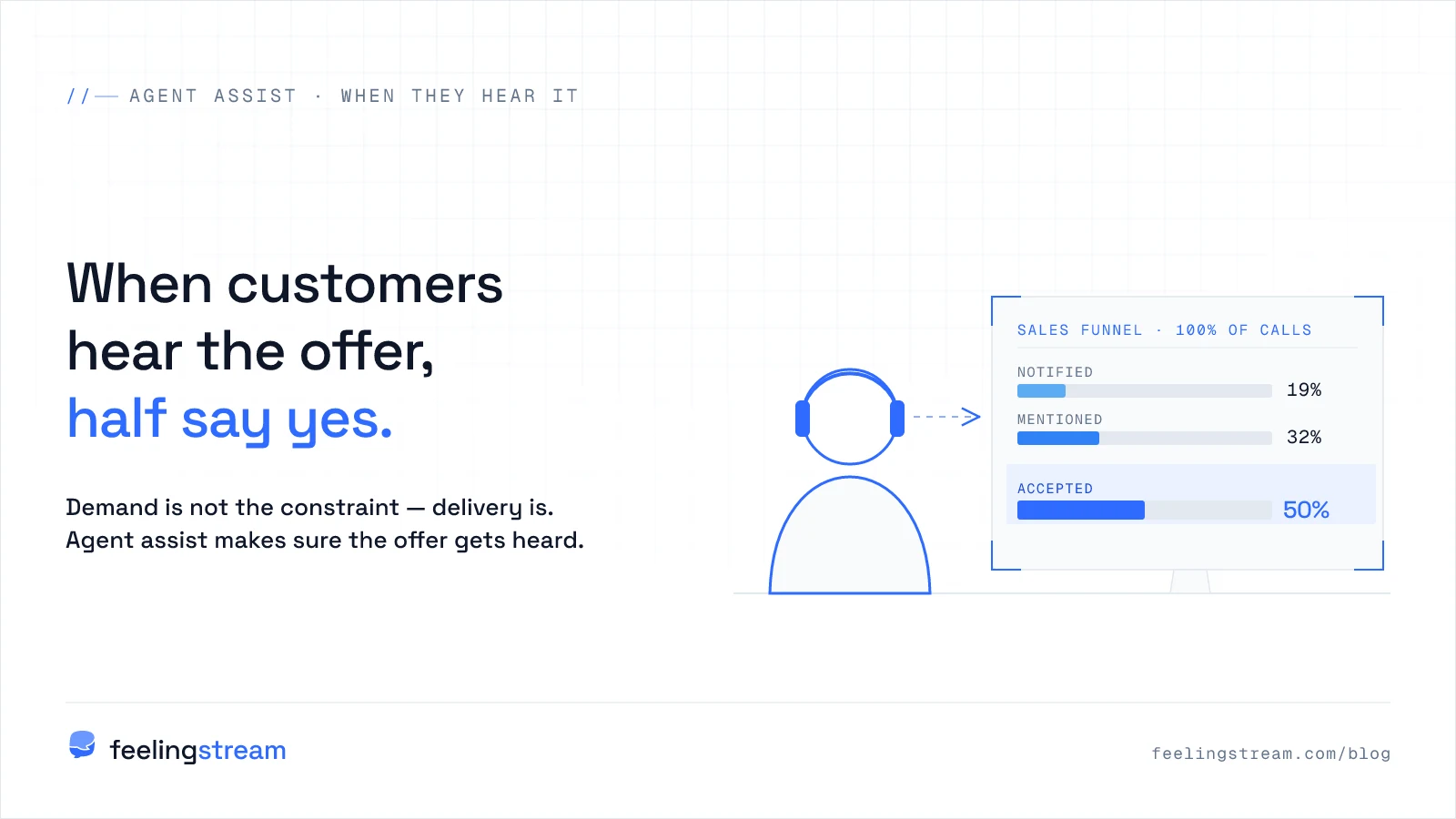
Here is a number that should change how contact centres think about sales: in one recent analysis of tens of thousands of inbound calls, when the campaign offer was actually mentioned, roughly half of customers said yes.
Half. For an insurance upsell made in the middle of a service call, that is an extraordinary conversion rate. It means the offer was strong, the pricing worked, and demand was real. And yet overall conversion was only around three per cent. The gap between those two figures is the whole story — and it has almost nothing to do with the customer.
The offer was never the problem
It is tempting, when campaign numbers land below plan, to blame the offer, retrain everyone or reach for a discount. The data points somewhere else. When a month of calls is analysed end to end, most of the lost revenue is not lost at the decision — it is lost before the pitch ever happens.
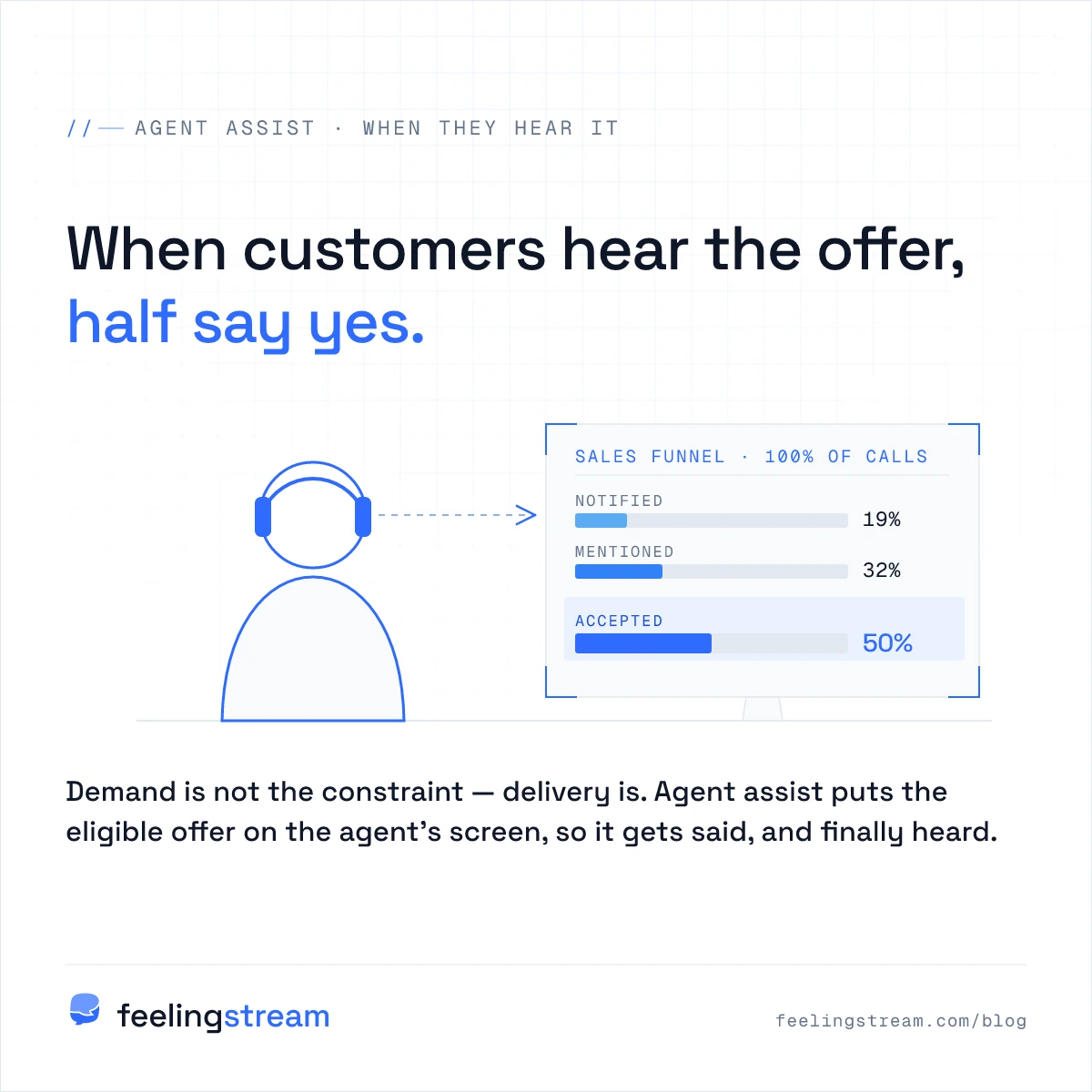
The funnel breaks into three sequential stages, and each is owned by a different part of the operation:
- Notification (process). Only about one in five eligible calls ever had the campaign correctly flagged to the agent. Four in five never surfaced it at all.
- Mention (agent behaviour). Of the calls where the campaign was flagged, agents actually raised it only about a third of the time.
- Acceptance (customer decision). Of the calls where it was mentioned, around half of customers accepted.
Read top to bottom, the leaks are damning: the customer stage — the one thing outside your control — is already performing at target. The two stages that are haemorrhaging opportunity are both internal execution, and both are fixable.
Why the offer never reaches the customer
None of this is because agents are careless. In the middle of a call, an agent is listening, navigating systems, recalling policy and deciding what to say next. Remembering which of a dozen live campaigns applies to this customer — and finding the natural moment to raise it — is one job too many under time pressure. So the offer slips. Not once, but across tens of thousands of calls a month.
Post-call review does not solve it. By the time anyone listens back, the call is over and the campaign has moved on. The help has to arrive while the conversation is still happening. That is exactly what agent assist does.
How agent assist closes the gap
Agent assist connects your campaign logic to the live conversation and works in three moves — the same three points where the funnel leaks. This is also how its performance is measured, so the effect shows up in your numbers rather than in anecdotes.
- Notify — when the call context is known, the agent sees the eligible campaign and its talking points automatically. No memorising a campaign matrix.
- Remind — if the offer has not come up, a short, well-timed nudge appears while there is still time to raise it naturally.
- Validate — at wrap-up, a closing summary records whether the offer was actually presented, ready for quality assurance and coaching.
The agent stays fully in control — the prompts are nudges to use, adapt or ignore, not a script to read. But the guessing ends.
Three things the product does well
Keep the benefits simple. Agent assist earns its place by doing three things:
- Puts the right offer in front of the agent at the right moment. The eligible campaign and its arguments appear based on what the call is about, so the agent never has to recall or search for them mid-conversation.
- Nudges before the moment passes, not after. A gentle reminder fires during the call if the offer has not been raised — cutting the missed openings and dead air that quietly lose sales.
- Makes execution measurable, call by call. Every conversation self-reports whether the offer was notified, mentioned and accepted — so improvement is something you can see, not something you hope for.
Three business wins that follow
Those capabilities translate into outcomes a sales or contact-centre leader can take to the board:
- More revenue from calls you already handle. Because the two leaking stages are internal and controllable, lifting them toward realistic targets could multiply accepted offers several times over — on the current call volume, with no new demand and no discounting. (This is an illustrative projection from the observed funnel, not a promise; we run the same model on your own volumes.)
- A narrower gap between your best and newest agents. When the right prompt arrives at the right moment, newer agents perform closer to your top performers and reach steady output earlier in onboarding — so campaign delivery no longer depends on who happens to pick up.
- Execution you can finally manage. Instead of inferring performance from topline conversion, managers see per-call reality — notified, mentioned, accepted — and can coach the specific gap, on the specific team, that is costing the most.
The takeaway
The most encouraging finding in that analysis was not the loss — it was the acceptance rate. Customers were ready to say yes. The offer simply was not reaching them. Close the two upstream gaps and you are not manufacturing demand; you are collecting sales that were always there, sitting in calls you already pay to handle.
When customers hear the offer, half say yes. Agent assist is how you make sure they hear it.
Frequently asked questions
If the offer converts so well, why is overall conversion low?
Because conversion is the last stage of a three-stage funnel. Even a 50% acceptance rate produces little revenue if the offer is flagged on only one in five calls and raised on only a third of those. The maths compounds: fix the upstream stages and the strong final stage finally has volume to work on.
Does agent assist replace the agent's judgement?
No. It surfaces the eligible campaign and a timely reminder; the agent decides whether and how to raise it. The conversation stays natural and the agent stays in control — the tool removes the recall burden, not the human.
How is this different from post-call sales monitoring?
Sales monitoring analyses calls after they happen to show where and why sales are won or lost. Agent assist acts during the call to change the outcome. Together they form a loop: learn what works from the data, then put it in front of agents live.
Is analysing every sales call secure enough for regulated industries?
Yes — ISO 27001, EU data residency, on-premises or closed-cloud deployment and PII masking. See data security in conversation analysis.
Where to go next
- The product: Agent assist
- The sales pillar: Sales monitoring — what it is and why it works
- The diagnosis behind the numbers: The sale was always there
- The upstream leak: The 40% problem
Curious what share of your eligible calls actually include the offer? Book a demo and we will turn a month of your own calls into a clear, owned plan for closing the gap.